

Original cover by Jae Lee and Peter Palmiotti; Marvel 1995. Michaela Colette Zacchilli's website is here.
 Detective Comics #388 (On Sale: April 29, 1969) has a so-so Batman cover by Irv Novick. The big news on this cover though is not the art, it is the price! DC comics used their flagship title to usher in the era of 15 cent comics.
 Captain Action #5 (On Sale: April 29, 1969) has another wonderful Gil Kane cover.
 Adventure Comics #381 (On Sale: April 29, 1969) has a Neal Adams Supergirl cover as she takes over Adventure Comics from the Legion of Super-Heroes.
 Action Comics #377 (On Sale: April 29, 1969) has another Curt Swan and Neal Adams Superman cover.
 You may know him as the egg salad-addicted Shepherd Wong from Woody Allen's What's Up, Tiger Lily? (originally International Secret Police: Key of Keys). He was, in fact, a contract player for Toho studios and a fine actor, appearing in classic samurai films like Kill!, Warring Clans, Samurai Assassin and Sword of Doom. In addition, like his Toho cohorts, he played roles in a variety of genres including yakuza flicks (Fangs of the Underworld, Bloody Territories), sci-fi (The Secret of the Telegian, The H-Man), kaiju-eiga (Mechagodzilla vs. Godzilla) and war pictures (Desperado Outpost, Japan's Longest Day).
 World's Finest Comics #185 (On Sale: April 24, 1969) has what the GCD calls a Neal Adams' cover, but you would have to be on drugs not to see that this was drawn by Curt Swan and only inked by Neal Adams.
 Showcase #83 (On Sale: April 24, 1969) has another wonderful Joe Kubert Nightmaster cover.
 Justice League of America #72 (On Sale: April 24, 1969) has a wonderful Joe Kubert cover.
 Hawk & the Dove #6 (On Sale: April 24, 1969) has a nice cover by Gil Kane.
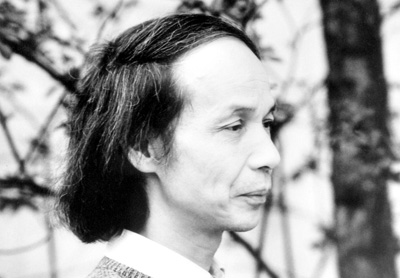 This is a documentary from 1994 about the brilliant contemporary and film composer Toru Takemitsu. If you're into Japanese cinema, you probably already have an awareness of his moody, abstract and utterly atmospheric work on such films as Kwaidan, Woman of the Dunes, Samurai Spy and tons of others. He was the first to score a Japanese film with traditional Japanese instruments (before Takemitsu, all Japanese film scores were Western-style). Additionally, unlike most other film composers, Takemitsu was involved with each film project from the beginning, developing his ideas in collaboration with the director, in many cases influencing the course of the film itself.
 Swing With Scooter #19 (On Sale: April 22, 1969) has a cover by Henry Scarpelli.
This is the first story Editor Murray Boltinoff wrote for DC since a House of Secrets story in 1963 and that story was the first one he had written since an Air Wave story in Detective Comics #72, in 1943. Boltinoff created the Air Wave character in Detective Comics #60 in 1942 and wrote all of the Air Wave stories for the next 13 issues.
This issue of Swing With Scooter marked Boltinoff's return to the pen. He would write over 90 stories for DC in the next 12 years, mainly horror stories, but also a good number of wars tales and a single Jimmy Olsen story for Superman Family #182.
Barbara Friedlander had been an Editor at DC a few years earlier, on some of the romance books and was also one of the early writers of Scooter, writing 11 Scooter tales in the first six issues of Swing With Scooter. This story was also her return to DC where she would write 11 more stories for Scooter and the romance books in the next few years.
Edited by Joe Orlando.
 Heart Throbs #120 (On Sale: April 22, 1969) has an interesting cover art combination: Jay Scott Pike and Neal Adams. I don't think they ever worked together again.
 Brave and the Bold #84 (On Sale: April 22, 1969) has a nice Batman and Sgt. Rock cover by Neal Adams. I love the way that the figures' shadows form a Bat-signal on the ground. This is also the only cover I think Adams signed in this manner; not his normal signature at all. Lastly, this is the second version of this cover that Neal drew. Below you can find the original which was rejected by DC.
 Investigating a strange amount of wine coming out of Chateaurouge, Bruce learns that it's occupied by Nazi's led by Von Stauffen. As a spy, Bruce is unable to learn what the secret is behind the wine, so he tries as Batman and comes to blows with Rock and Easy Company again who happen to be in the area. However, during their scuffle over a bottle of the Chateaurouge wine, they find that the Nazi's are smuggling weapon parts in the bottles to be used during the D-Day invasion. Batman and Easy Company then work together to stop Van Stauffer.
 Bat Lash #5 (On Sale: April 22, 1969) has a nice cover by Nick Cardy.
 Witching Hour #3 (On Sale: April 17, 1969) has an interesting cover art combination: Mike Sekowsky and Nick Cardy and it creates a really nice, moody piece.
 Flash #189 (On Sale: April 17, 1969) has the first and the best of three Joe Kubert Flash covers. You couldn't see this on the stand and not run out and buy it.
 Batman #212 (On Sale: April 17, 1969) has a nice Irv Novick cover.
 Sugar and Spike #83 (On Sale: April 15, 1969) has its typical Sheldon Mayer cover. I failed to note that starting two issues previous the "With Bernie the Brain" tag-line was added to the cover logo.
 Star Spangled War Stories #145 (On Sale: April 15, 1969) has another Joe Kubert Enemy Ace cover.
 Metal Men #38 (On Sale: April 15, 1969) has a cover by Mike Sekowsky and George Roussos.
 Debbi's Dates #2 (On Sale: April 15, 1969) has an unidentified cover. Anyone know who this is?
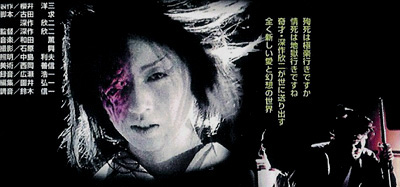 Saw a couple of good kaidan-eiga (supernatural period dramas) recently. Crest of Betrayal (1994) takes the Ghost of Yotsuya story and mushes it together with the Chushingura, resulting in the wicked ronin Iemon (actually not so wicked in this version) as a member of the Loyal 47 Ronin of the Asano clan. (He was apparently hired on right before Lord Asano lost it and tried to hack up the manipulative Lord Kira; Asano's subsequent enforced seppuku has, of course, left his retainers bent on revenge.) Iemon's wife, Oiwa, is poisoned by the family of Oume, a rival for Iemon's affections, and becomes the classic long-haired, vengeful lady ghost. Kinji Fukasaku directs with style and flair. Playing Iemon is Koichi Sato, whom you might have seen in the Shinsengumi flick When the Last Sword is Drawn (2003, reviewed in my forthcoming book, Warring Clans, Flashing Blades, due out in June). Oiwa is played by the beautiful and buxom Saki Takaoka (who'll be co-starring in a film with Danny Glover this summer). And you won't want to miss cult film fave Renji Ishibashi in a bizarre turn as Oume's rich weirdo daddy.
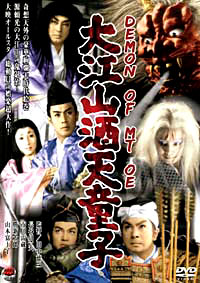 Demon of Mt. Oe is an all-star Daiei epic from 1960 starring Raizo Ichikawa, Shintaro Katsu, Kazuo Hasegawa, Tamao Nakamura, Kojiro Hongo, Jun Tazaki and many others. Raizo plays Yorimitsu "Raiko" Minamoto, a storied samurai warrior of Japan's medieval period known for going up against supernatural foes. (Kei Sato played Raiko in the classic Kuroneko, another film drawing on the spooky folklore of the period). Demon of Mt. Oe offers a thrilling blend of samurai sword action and fanciful (and at times cheesy) special effects involving a giant spider, demonic creatures coming down from the skies, spectral sorcerers and the like. I highly recommend this forgotten gem to anyone interested in Japanese film and folklore.
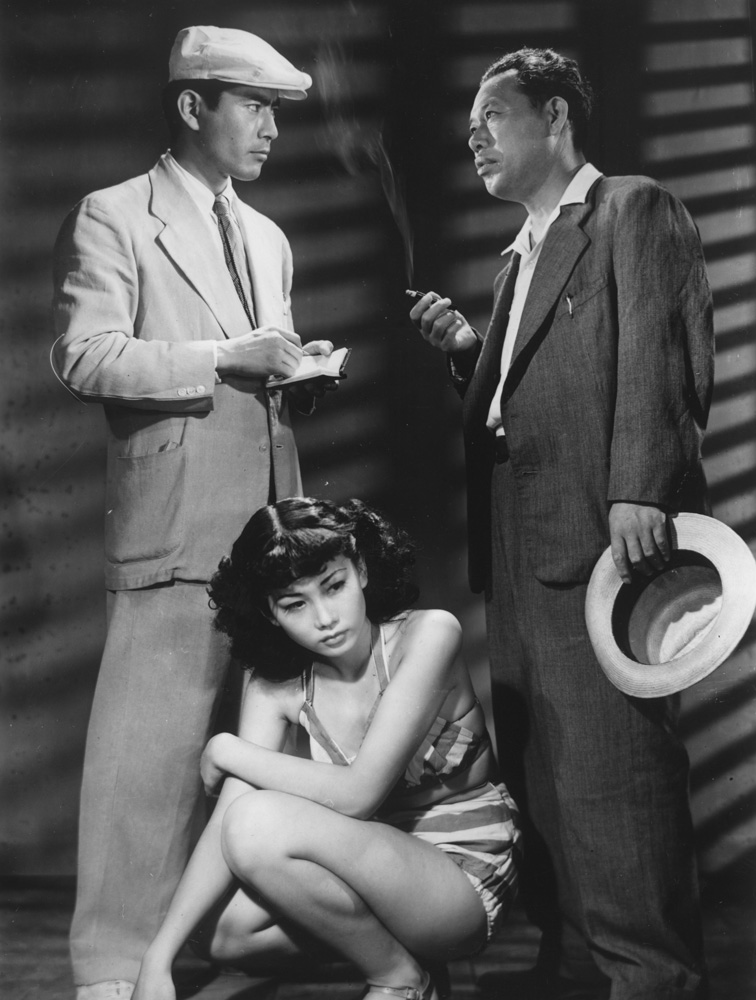 1949's Stray Dog with Takashi Shimura (and the very hot Keiko Awaji, between).
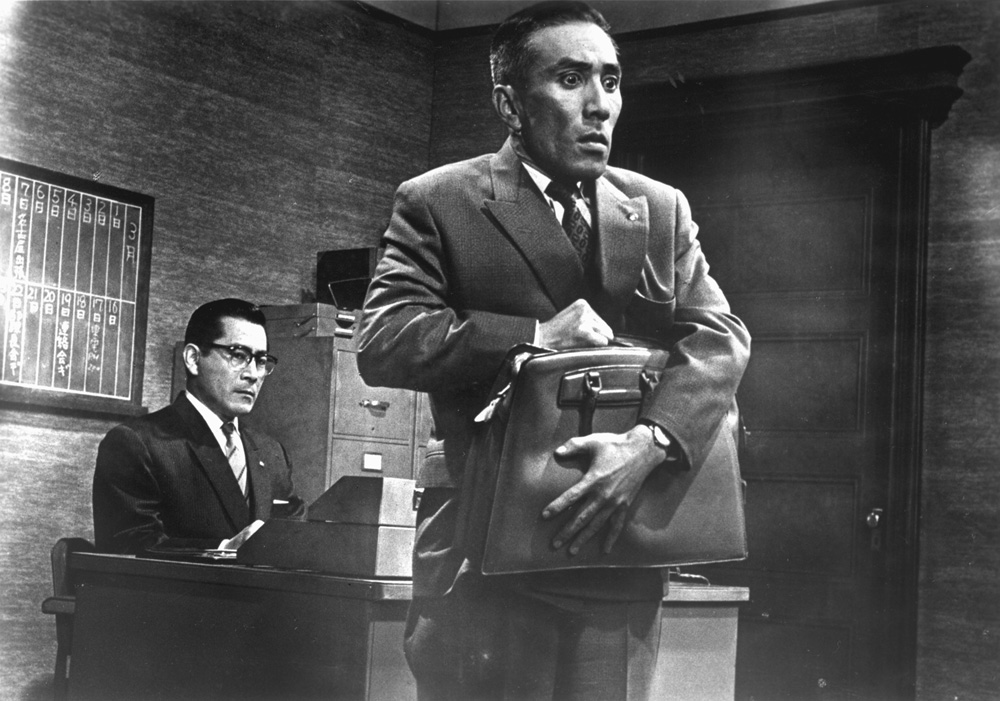 From The Bad Sleep Well (1960). That's the great character actor Ko Nishimura on the right. Mifune's character is slowly, methodically driving him insane.
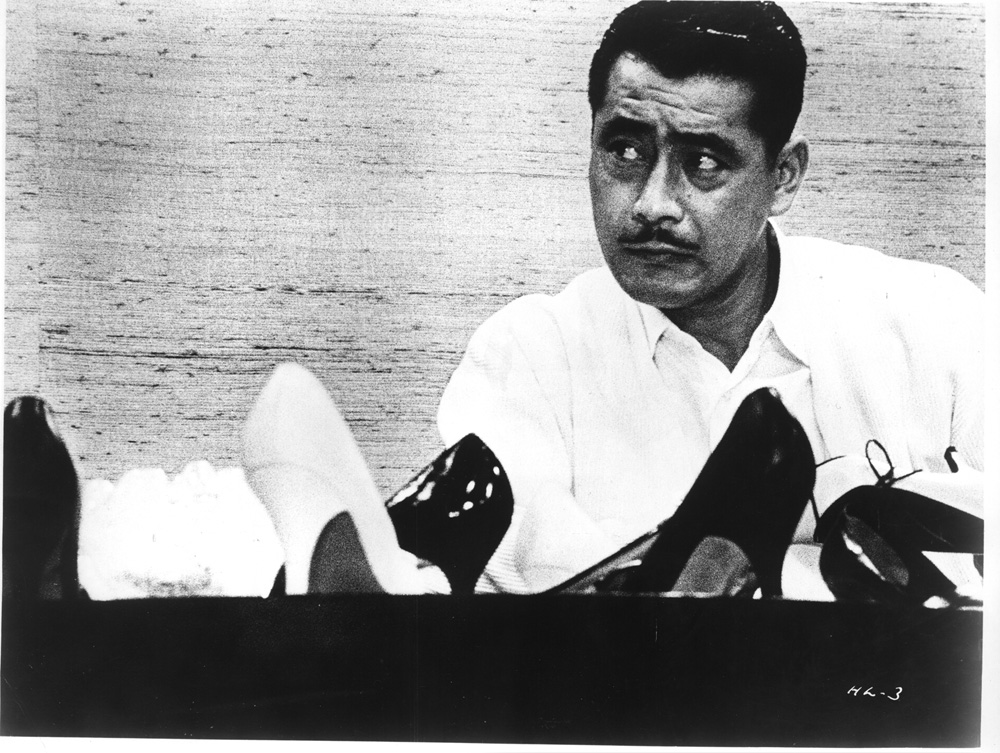 From the taut kidnap thriller High and Low (1963), my hands-down, all-time favorite Kurosawa picture.
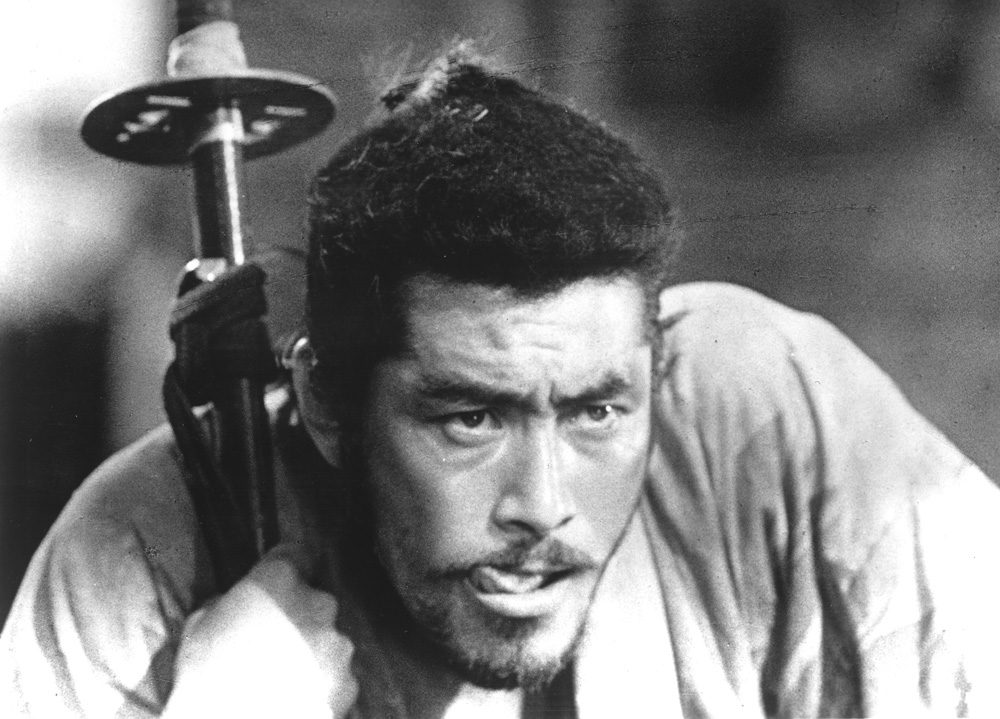 As farmer-cum-swordsman Kikuchiyo in Seven Samurai (1954).
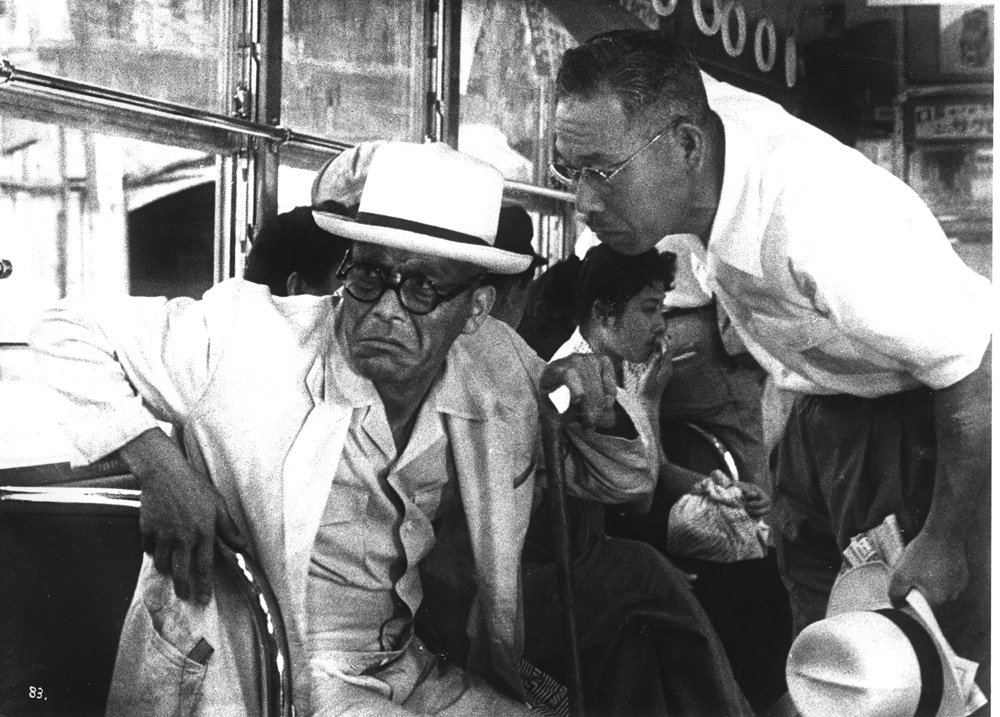 One year after Seven Samurai, Mifune transformed himself into a paranoid, A-bomb-obsessed old man for I Live In Fear (Takashi Shimura, right).


